Structural Drying and Dehumidification in Marietta, GA
After the water is out, the structure still holds moisture, and Marietta crews dry studs, subfloors and concrete with air movers and dehumidifiers until readings say they are done.
(888) 532-4616Set up the drying equipment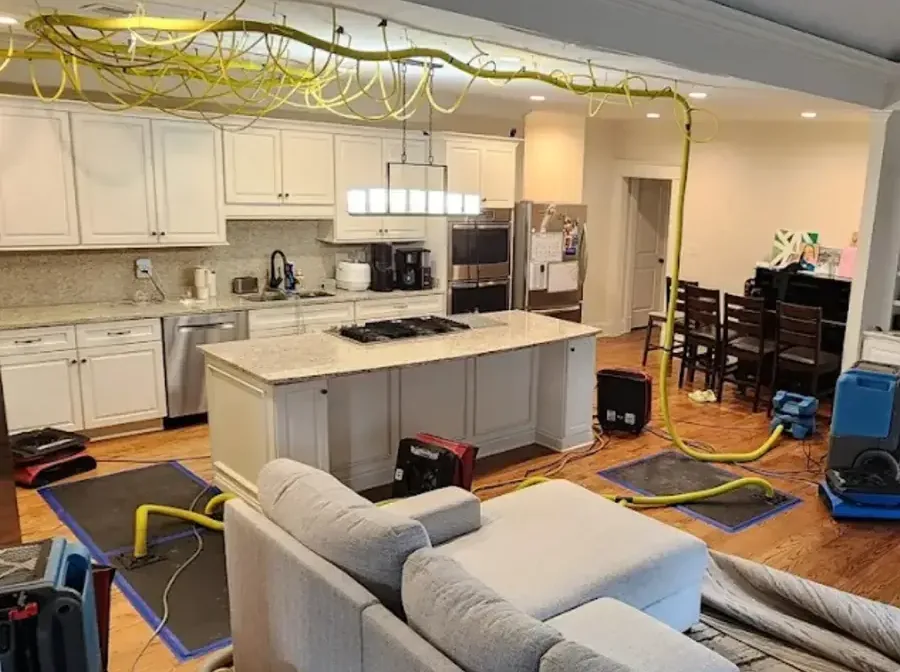
First steps for structural drying and dehumidification in Marietta
- 01Get the water out first Extract standing water and remove soaked padding so equipment is not drying a pool.
- 02Leave wet surfaces alone Do not paint, seal or cover wet materials, since that traps moisture inside.
- 03Keep the building closed Keep doors and windows shut once equipment is running so humid outdoor air stays out.
- 04Let the crew monitor Readings on each visit decide when equipment is adjusted or removed.
Removing standing water does not make a building dry, because studs, subfloors, concrete and cabinet bases hold moisture that has to be pulled out with controlled airflow and dehumidification. In a humid subtropical climate the air outside will not do that job, and the September 2021 flooding of many homes and businesses showed how many structures needed documented drying.
Rapid local response
Dispatch runs 24/7, and active water is treated as urgent, because it moves into subfloor and drywall within hours.
IICRC S500 drying standard
Moisture gets mapped first. Air movers and LGR dehumidifiers then run until the readings match a dry reference, not until the surface looks dry.
Claim-ready documentation
Daily moisture readings, psychrometric logs and timestamped photos taken before any demolition go into the file an adjuster reviews.
Local water know-how
Red clay, creek-side lots, crawl spaces, basements on sloped ground and attic equipment shape how water moves through homes in west Cobb.
What does structural drying and dehumidification cost in Marietta, GA?
Structural drying cost depends on the loss class, the number of rooms and how long equipment has to run. These ranges show small, multi-room and whole-level drying jobs.
Class 1 or 2 in one area
- Air movers and an LGR dehumidifier
- Several days of equipment
- Readings every visit
Several rooms or Class 3
- Containment and extra equipment
- Wall cavity drying
- Psychrometric logs
Class 4 or a whole level
- Desiccant dehumidifiers
- Hardwood and concrete dried
- Longer monitoring
Ranges are typical, never a quote: the category of water, square footage, material class and how fast drying started move the number most.
Work out a closer range in the cost calculatorHow structural drying and dehumidification gets done, step by step
The tech who does the walkthrough maps moisture before any equipment goes down, so the plan matches what is actually wet. Equipment stays until the readings say dry.
Classify the loss
The crew sorts the loss by class and water category and measures the wet area.
Place the equipment
Air movers, LGR dehumidifiers and mats go in by the readings.
Monitor each visit
Temperature, humidity and moisture readings are logged and equipment is adjusted.
Remove at dry standard
Equipment comes out when the materials match dry reference points.
How drying equipment works
Air movers push dry air across wet surfaces, while LGR dehumidifiers pull moisture from the air so the materials keep releasing water. Equipment is sized by the class of the loss and the area affected, then adjusted each day.
- Class 1 and 2 jobs, where one area or a few materials are wet
- Class 3 jobs, where water came down from overhead into walls and floors
- Class 4 jobs, where hardwood or concrete holds deep moisture
- Whole-level jobs that need desiccant dehumidification
Walls still damp after the water is gone? Talk to a crew about a documented dry-out.
(888) 532-4616Marietta drying helpReadings and documentation
Moisture readings and psychrometric logs of temperature and humidity are taken on every visit and compared with dry reference points. When the numbers match, equipment comes out. Those records are what an adjuster uses to see that the work was needed and complete. When repairs need a permit, the city's inspectors visit in person, with virtual inspections phased out beginning November 1, 2024.
Where drying fits
Drying follows extraction on every job, from water extraction after a leak to flood and storm water cleanup after creek flooding, and the equipment plan changes with the loss.
Structural drying and dehumidification across Marietta and nearby towns
Drying equipment is placed in homes, rentals and businesses across ZIP 30060, from the historic districts near the Square to properties along Cobb Parkway and Powder Springs Street, with readings logged on every visit.
The same service nearby: structural drying and dehumidification in Austell, Smyrna, Mableton.
Structural Drying and Dehumidification questions in Marietta, GA
Water still spreading?
Shut off the water if you can and keep clear of wet outlets. Dispatch runs 24/7.
(888) 532-4616 Marietta drying helpHow long does structural drying take?
It depends on the materials, the amount of water and the weather, so the crew does not set a date. Equipment runs until readings on every material match dry reference points.
Why are dehumidifiers needed when fans are running?
Fans move air, but dehumidifiers remove the moisture that air picks up. Without them, humid air in a closed building only moves water around instead of out.
Can wet drywall and insulation be dried in place?
Some can, especially after clean water, but soaked insulation and swollen drywall are usually removed. Meters and a thermal camera show which materials can be saved.
What do the daily readings prove?
They show the starting moisture, the progress on each visit and the final dry readings. Adjusters use that record to see that the equipment was needed and the job was finished.
Does the weather matter in a humid climate?
Yes. The area has a humid subtropical climate, so the air outside carries moisture too, and the crew keeps the building closed while equipment runs.
Dry the structure and prove it
The drying team places equipment by the readings, logs every visit and pulls it out only when the materials are dry.
(888) 532-4616Plan the drying