Basement Flooding Cleanup in Austell, GA
A basement collects water from every direction: the hillside, the slab, a failed sump or a burst pipe. The extraction crew pumps it out, removes wet finishes and dries the walls and floor.
(888) 532-4616Basement taking on hillside water? Call now.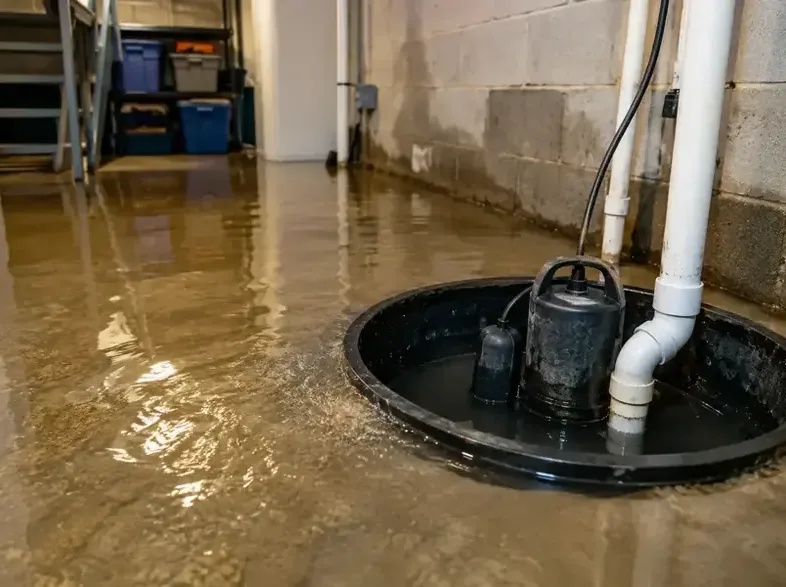
First steps for basement flooding cleanup in Austell
- 01Keep out until power is off Do not step into a flooded basement if outlets, cords or appliances are near the water.
- 02Check the sump If the pump has power and a clear discharge, let it run; if it failed, note it for the claim.
- 03Move belongings up the stairs Lift boxes, electronics and furniture out of the water and away from wet walls.
- 04Note where the water came in Watch where it enters: a wall joint, the slab edge, a door, a drain or a pipe.
Many homes in Austell were built into sloped lots, with a basement dug into the hill and the back wall below grade. Red clay holds water against that wall after a heavy storm, and it finds the joints in the block and the crack where the wall meets the slab. A failed sump pump, a water heater in the corner or a burst pipe in the ceiling can flood the same space from inside.
Rapid local response
Dispatch runs 24/7, and active water is treated as urgent, because it moves into subfloor and drywall within hours.
IICRC S500 drying standard
Moisture gets mapped first. Air movers and LGR dehumidifiers then run until the readings match a dry reference, not until the surface looks dry.
Claim-ready documentation
Daily moisture readings, psychrometric logs and timestamped photos taken before any demolition go into the file an adjuster reviews.
Local water know-how
Red clay, creek-side lots, crawl spaces, basements on sloped ground and attic equipment shape how water moves through homes in west Cobb.
What does basement flooding cleanup cost in Austell, GA?
In Austell, GA, basement flooding cleanup typically runs $2,500 to $15,000, depending on the water category, the depth and whether the basement is finished with carpet, framed walls and drywall.
Unfinished, shallow water
- Pump-out and extraction
- Block wall and slab drying
- Daily moisture readings
Finished basement
- Carpet and pad removal
- Flood cuts and insulation removal
- Dehumidification of the level
Deep or contaminated water
- Category 3 removal and cleaning
- Antimicrobial treatment
- Extended slab and block drying
Ranges are typical, never a quote: the category of water, square footage, material class and how fast drying started move the number most.
Work out a closer range in the cost calculatorHow basement flooding cleanup gets done, step by step
The tech who does the walkthrough maps moisture before any equipment goes down, so the plan matches what is actually wet. Equipment stays until the readings say dry.
Find the source and depth
The tech sets the water category, checks the sump and maps moisture across walls and slab.
Pump and extract
The extraction crew pumps deep water and extracts carpet and hard floors.
Strip wet finishes
Saturated carpet, pad, insulation and drywall come out so the block and framing can dry.
Dry the level
LGR dehumidifiers and air movers run in a closed-off basement until block and slab read dry.
Where basement water comes from
- Hydrostatic pressure: saturated clay pushing water through block joints and slab cracks
- Surface runoff: water from uphill yards and short downspouts running down the back wall or through a walkout door
- Sump failure: a pump that quits, loses power or cannot keep up in a long storm
- Inside sources: water heaters, washers and burst pipes, plus sewage pushed up through a floor drain
The source sets the water category. Groundwater and runoff are often treated as Category 3; a supply pipe starts as Category 1.
Water rising in the basement right now?
(888) 532-4616Ask for a basement pump-out right awayFinished basements
Carpet over a slab, framed walls with fiberglass insulation and drywall to the floor all trap water. The extraction crew pulls the water, then the tech checks how far it wicked up the walls. Wet insulation and the bottom of the drywall come out with a clean flood cut so the studs and the block behind them can dry. The EPA's indoor air quality guidance explains why wet basement materials should not be left to sit.
Drying block and concrete
Concrete block and slabs hold a lot of water and give it up slowly, and damp clay outside keeps feeding them. LGR dehumidifiers run in a closed-off basement with air movers aimed at the walls, and readings on the block and slab are taken daily. Basements often take longer than main-floor rooms. For water from Sweetwater Creek or a street flood, see flood and storm water cleanup.
Basement flooding cleanup across Austell and west Cobb
Austell Water Damage Restoration covers ZIP 30106 and 30168, from Downtown and Broad Street and the homes along Sweetwater Creek out to Clarkdale, Floyd Road, Hicks Road, Maxham Road and the apartment blocks off Thornton Road.
Nearby coverage reaches Mableton, Powder Springs, Lithia Springs, Douglasville, Smyrna and Marietta.
Related water damage services
Basement Flooding Cleanup questions in Austell, GA
Water still spreading?
Shut off the water if you can and keep clear of wet outlets. Dispatch runs 24/7.
(888) 532-4616 Ask for a basement pump-out right awayWhy does my basement flood after heavy rain?
Clay soil around Austell drains slowly, so water builds up against basement walls and pushes through block joints and slab cracks. Short downspouts and yards that slope toward the house make it worse.
Is basement flood water clean?
It depends on the source. A burst pipe starts clean, but groundwater, runoff and floor drain backups are usually treated as contaminated, which means porous materials come out.
Can the carpet in a finished basement be saved?
Rarely. Carpet over a slab with runoff or groundwater usually comes out with its pad. Clean water from a pipe caught early is the main exception.
Why does a basement take longer to dry?
Concrete and block are dense and release water slowly, and the wet soil outside keeps feeding moisture in. Basements usually need more dehumidification and more days.
Who fixes the cause of the leak?
A waterproofing or drainage contractor handles grading, drains and sump systems. The restoration team removes the water and dries the basement.
Does insurance cover a flooded basement?
A sudden pipe or water heater failure is often covered, while groundwater seepage and surface water often are not. Sump failure may need an endorsement. Check with your own insurer.
Basement under water? Get it pumped and dried.
Water in a basement soaks carpet, framing and block walls fast and dries slowly. The extraction crew pumps it out and sets up the drying.
(888) 532-4616Start the basement dry-out tonight