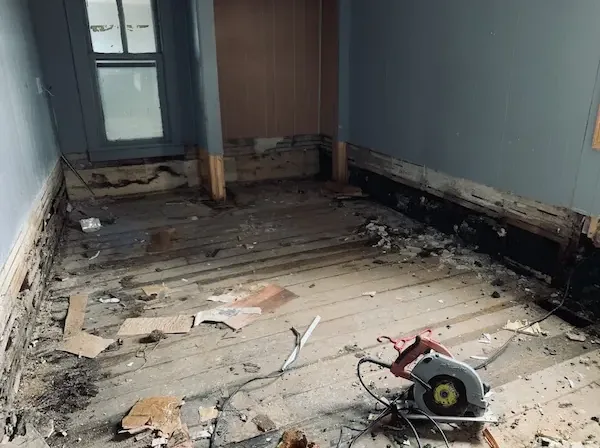
Many Austell homes built from about 1978 to 1995 have polybutylene supply pipe, and a failed fitting inside a wall can run for hours before a stain appears. By the time a ceiling sags or a floor feels soft, the water has usually traveled well past the break.
Key takeaways
- Many homes built about 1978 to 1995 have polybutylene supply pipe, so a burst can come from a house that has never leaked before.
- A failed pipe inside a wall or ceiling wets drywall, insulation and flooring before any stain shows.
- Close the main water valve first, then deal with the water already on the floor.
- Older mill-village and railroad-era houses near downtown and Clarkdale add galvanized pipe to the list of weak points.
- Drying is finished when moisture readings match a dry spot in the house, not when the surface looks dry.
Why a polybutylene burst catches homeowners off guard
Polybutylene was used as supply pipe in many homes built about 1978 to 1995. Austell has 1980s to 2000s subdivisions, so a good number of local houses fall inside that window.
A failure rarely announces itself. A fitting weeps behind a wall or a length of pipe lets go, and the supply keeps pushing water until someone closes the main valve.
Most of that water goes where nobody is looking, which is why the first sign is often a stain, a soft floor or the sound of running water. A fast response to burst pipe water damage limits how far it travels.
- A damp patch on a wall or ceiling that spreads over a day or two.
- Paint that bubbles or baseboards that begin to warp.
- A floor that feels spongy near a bathroom, kitchen or water heater.
- The sound of running water when every fixture is off.
What the water does behind the drywall
Wicking and spreading
Drywall and insulation pull water upward and sideways like a wick. A wet patch the size of a dinner plate can sit on top of a much larger wet area inside the cavity.
Framing holds moisture longer than the paint on the surface suggests, which is why a wall that looks dry can still read wet on a meter.
Floors, cabinets and rooms below
Water that reaches the floor travels along the subfloor until it finds a seam, a drain or a low spot. In a two story house it can drip through the ceiling below, and where a lower level is cut into a slope it can follow the wall cavity down.
Cabinets and trim absorb water from the bottom edge, so swelling shows up weeks later if the area was never dried.
Why the first day matters
The paper face of drywall softens soon after a soaking, and insulation loses its shape once it is wet. By the second day the chance of mold growth rises, so the first call should not wait for the plumber to finish.
Every hour of delay widens the wet zone, because wet materials pass water to dry neighbors.
First steps when a supply pipe lets go
Closing the main water valve comes first, because every extra stretch of running supply adds to the wet area. The rest of the list can be done in any order that keeps people safe.
Water on a hard floor can be mopped, but water inside a wall cannot, which is why the main valve matters more than any towel.
- Close the main water valve to stop the supply feeding the break.
- Switch off power to wet rooms only if the panel can be reached without standing in water.
- Photograph wet walls, floors and belongings before anything is moved.
- Lift small furniture and electronics onto dry surfaces.
- Stay out of any room where a ceiling sags or bulges.
Older houses and other weak points in Austell
The service area is a mix. Small railroad-era and mill-village houses near downtown and Clarkdale are common, and older houses often carry galvanized pipe rather than polybutylene.
The service area includes Downtown and Broad Street, Clarkdale, Maxham Road, Hicks Road, Floyd Road and Riverside Parkway, and a pipe can fail on any of those streets.
Postwar brick ranches, newer slab homes, and apartments and townhomes along roads such as Veterans Memorial Highway and Thornton Road round out the picture, so the first job is always finding where the water went. A leak that ends in a stained ceiling falls under ceiling leak water damage.
- Brick ranches on crawl spaces: water can drain under the floor and stay out of sight.
- Subdivision homes with basements: water can run down a wall cavity to the lower level.
- Slab homes: water spreads across hard flooring and into the base of the walls.
- Apartments and townhomes: water can cross shared walls and ceilings.
How extraction and drying work after a burst
Extraction and tear out
The extraction crew pulls standing water and soaked padding first, then opens the wall at the base to see how far the water traveled. Drywall that stays wet is cut back past the wet edge so air can reach the framing, and soaked insulation is bagged rather than dried in place.
The first pass uses water extraction equipment sized to the room, from portable pumps to truck-mounted units.
Not everything needs to come out. Solid wood trim and framing are normally dried and kept, while soaked insulation and padding are not worth saving, and the readings decide the rest.
Drying to a reading
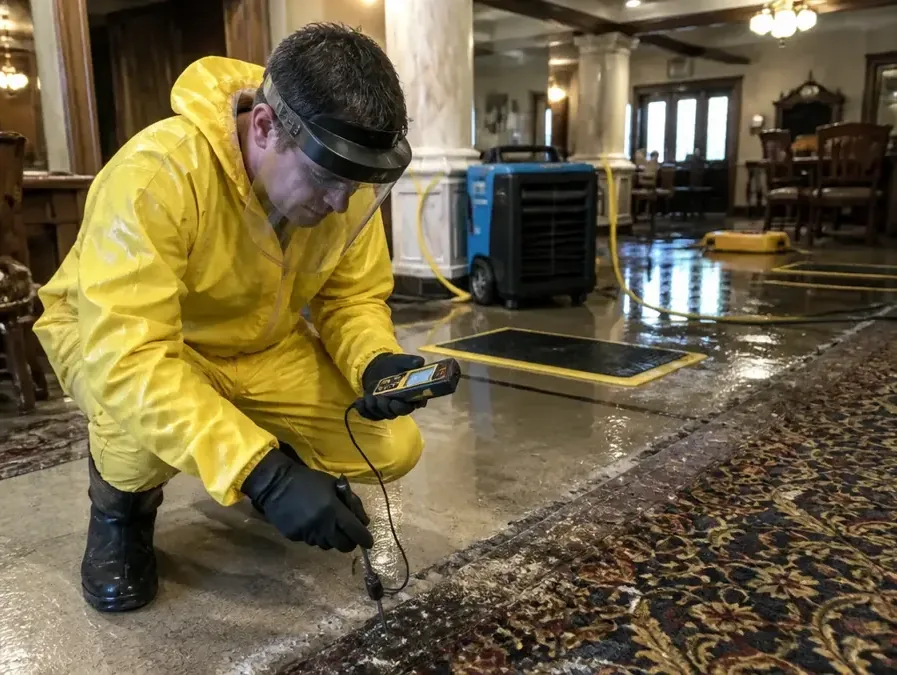
Readings are taken on drywall, framing and subfloor and compared with a dry spot elsewhere in the house. The equipment stays until the numbers match, which is the core of structural drying.
- Air movers push dry air across wet surfaces.
- Dehumidifiers pull moisture out of the air so it cannot settle back into the walls.
- Daily readings decide when the equipment leaves.
- Mold can begin within 24 to 48 hours of a soaking, so drying starts before the repair is finished.
After the break is repaired
A plumber repairs or replaces the failed section, and the drying team works around that schedule. Walls are closed only after the readings return to normal.
A burst is also the moment to ask the plumber about the rest of the supply pipe in the house, since pipe from the same period may run through other walls.
Water that reached the floor below needs the same attention as the break itself. A plumber ends the source, but wet drywall in a lower room still has to be opened, dried and checked.
- Ask the plumber what material sits behind the repair.
- Keep photos, moisture readings and the drying log in one folder.
- Leave walls open until the readings are normal.
Questions
Does polybutylene pipe always fail?
No. Many homes have it and never leak. The concern is that a failure can happen inside a wall or ceiling, where water runs unseen for hours.
How can a homeowner find out what supply pipe a house has?
A plumber can identify the material where the pipe is visible, such as near the water heater, under sinks or at the main valve. The year the home was built is also a clue.
How soon should wet drywall be handled?
As early as possible. Wet drywall and insulation start to break down quickly, and mold can begin within 24 to 48 hours.
Who repairs the pipe and who handles the water?
A plumber repairs the pipe. The restoration team extracts the water, removes wet materials and dries the structure, and the two jobs usually run in sequence.
Can a burst in an upstairs wall damage the rooms below?
Yes. Water follows framing and drips through ceilings, so rooms below can be wet even when the break is above.
What if a wall looks dry a day after the repair?
The surface can dry while the cavity behind it stays wet. Readings on the drywall and framing show whether the wall is really dry.