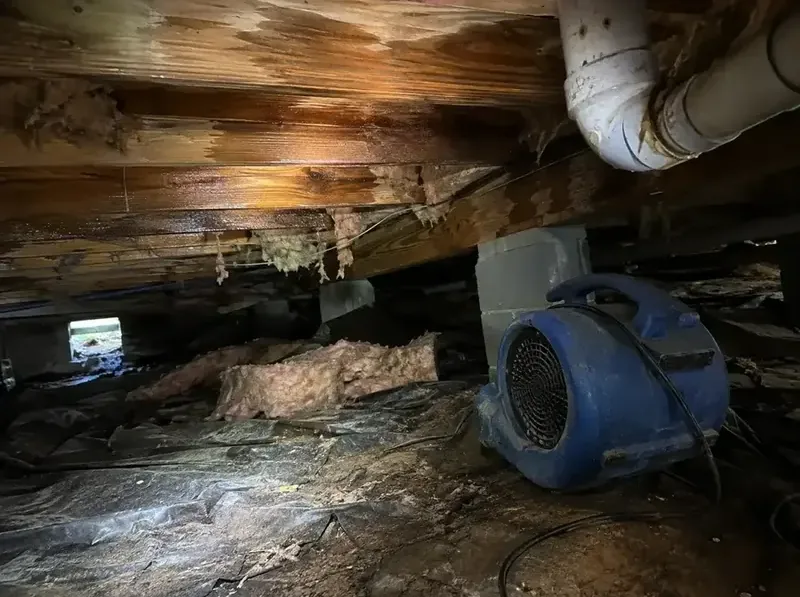
Postwar brick ranches in Austell often sit on crawl spaces, and Georgia red clay drains slowly. After a heavy storm, water that cannot soak in can collect under the floor where nobody sees it.
Key takeaways
- Austell gets about 50 inches of rain a year, with heavy summer thunderstorms and tropical storm remnants in late summer and fall.
- Georgia red clay drains slowly and pushes water toward crawl spaces and basements.
- Standing water and wet insulation wet the joists and subfloor from below, long before the room above looks damaged.
- The water is pumped out, wet insulation is pulled and the framing is dried with moisture readings.
- A flashlight check from the access hatch can show standing water without entering the space.
Red clay, brick ranches and slow drainage
The Austell housing mix includes postwar brick ranches on crawl spaces, 1980s to 2000s subdivisions with basements cut into sloped lots, and newer slab homes. Each style meets heavy rain differently.
A crawl space sits low, and clay holds water at the surface instead of letting it drain down. Some of that water arrives from the roof and the yard, and some from the soil itself after a long wet spell, and a crawl space does not drain by itself.
That position makes the crawl space the first place to look after a storm, and crawl space water removal starts there.
- Brick ranches on crawl spaces: water collects under the floor.
- Subdivision homes with basements: water presses against below-grade walls.
- Slab homes: water reaches the edge of the slab and the base of the walls.
What standing water does under a floor
Insulation and joists
Wet insulation sags and holds water against the underside of the floor. Joists absorb moisture from the soil and from the insulation, and they stay damp long after the pooling stops.
Wood that stays damp invites mold, so drying has a deadline.
Subfloor and flooring above
Moisture rises into the subfloor, and the flooring above can swell, cup or loosen. The room can look fine for days while the damage builds underneath.
Pipes, ducts and equipment under the floor
Pipes and ducts often run through a crawl space, and wet insulation around them can drip and sag. Damp conditions also strain equipment in the space and anything stored there.
Standing water or damp air?
A light and a look through the access hatch tell the two apart. Standing water shines on the soil, while damp air shows as condensation and a musty smell.
The crawl space water check walks through the signs in order.
A careful look does not require climbing in. The access hatch gives a view of the soil, the insulation and the foundation wall.
Standing water has a source and a level. A pool that stays after the rain has stopped points to water that cannot drain, while a damp patch that dries out between storms points to humidity or a small leak.
- Water shining on the soil or running along the foundation wall.
- Insulation that sags, drips or has dropped from the joists.
- A musty smell that builds after rain.
- Condensation on pipes or ducts.
How the water is removed and the space dried
Crawl spaces are tight, so crews size pumps and hoses to the space and work from the access hatch outward.
Pump out
The extraction crew sets pumps in the low spots and removes standing water, and then pulls wet insulation out of the space. Pumping is the heart of the job.
- Pumps remove standing water from the low spots.
- Wet insulation is pulled and bagged.
Dry the framing
Equipment dries the joists and the underside of the subfloor, and readings decide how long it stays. Drying continues through structural drying until the wood matches a dry reference reading.
Equipment stays on until the framing reads dry, and the log records each visit.
- Air movers and a dehumidifier dry the joists and the underside of the floor.
- Readings show when the framing is dry.
Summer storms and tropical remnants
Austell gets heavy summer thunderstorms and tropical storm remnants in late summer and fall. On September 20 to 21, 2009, an estimated 10 to 20 inches of rain fell on west metro Atlanta, according to the National Weather Service, and Sweetwater Creek flooded homes and streets.
Noses Creek drains toward Sweetwater Creek from Powder Springs, which is a reminder that water in this area moves from higher ground toward the low spots.
After weeks of humid heat, the air under a floor is already damp, so wet insulation and framing dry slowly without equipment.
The 2009 flood is the extreme case, but ordinary summer thunderstorms can wet a crawl space when the clay has no room left to take water.
When the problem is bigger than a crawl space
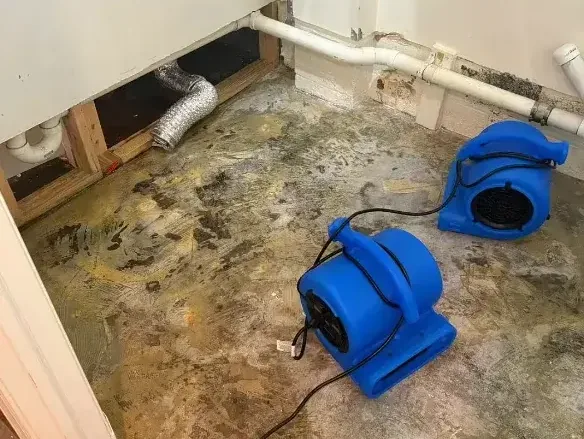
Water under a floor can be the first sign of a larger problem. If water also shows in living areas, along baseboards or in wall bases, the scope grows beyond the crawl space.
Subdivision homes with basements and newer slab homes follow the same logic, with their own paths for water.
- Water in a living space means extraction and drying above the floor too.
- Stains on walls near the floor suggest water has wicked upward.
- A musty smell that stays after drying points to materials still wet.
Keeping watch and keeping water out
The restoration team removes water and dries the structure, while drainage fixes belong to a landscaper or a drainage contractor.
A short routine after heavy rain catches crawl space water early, when it is still a pump job and not a rebuild. Photographs of the soil, the insulation and the access hatch give a clear comparison from one visit to the next.
- Walk the outside of the house and look for water near the foundation.
- Open the access hatch and look with a light.
- Check whether insulation has sagged or dropped.
- Look again a day or two later, since water can be slow to arrive or leave.
- Send downspouts out and away from the foundation.
- Keep soil sloping away from the house.
- Check that the access hatch closes tightly.
Questions
Why do Austell crawl spaces collect water?
Georgia red clay drains slowly, and Austell gets about 50 inches of rain a year, so water can collect under the floor after heavy storms.
How can a homeowner tell if there is standing water?
A flashlight through the access hatch shows water shining on the soil, sagging insulation or water along the foundation wall.
What happens to wet insulation?
Wet insulation is pulled out rather than dried in place, because it holds water against the floor above.
Does a crawl space need drying after the water is gone?
Yes. Joists and the subfloor stay damp long after the pooling stops, so they are dried until moisture readings match a dry reference.
Can a crawl space leak into the room above?
Yes. Moisture rises into the subfloor and flooring, and wet insulation can hold water against the floor above.
Can the crew work in a tight crawl space?
Yes. Equipment is sized to the space and set up from the access hatch, and moisture readings are taken on the joists and subfloor from below.